Understanding How Google Local Service Ads Work

Google local service ads
Pixelated 3D computer cursor arrow, representing digital marketing services for pest control and lawn care businesses.

Google Local Service Ads can be a Huge Boost to your Lawn or Pest Business

Last updated: July 2026

We’ve put together this handy guide to give you an overview of Google Local Services Ads: what they are, what changed in the 2025 overhaul, what the benefits and drawbacks are, and how to decide whether they’re worth it for your pest control or lawn care business.

What Are Google Local Services Ads?

Google Local Services Ads (LSA) are a pay-per-lead ad format built specifically for home service businesses. Your ad appears at the very top of the search results page, above regular Google Ads, above the map pack, above everything, and you pay only when a customer actually calls or messages you, not when they click.

That placement and pricing model are why LSA is worth your attention. When a homeowner finds a trail of ants in the kitchen at 9pm, the first three results they see are Local Services Ads, and those leads tend to be people ready to book, not people browsing.

To participate, your business must first pass Google’s screening and verification process: background checks, license verification, and insurance verification, handled through Google’s third-party partners. Businesses that pass earn the blue Google Verified badge on their ads, which tells customers Google has vetted you.

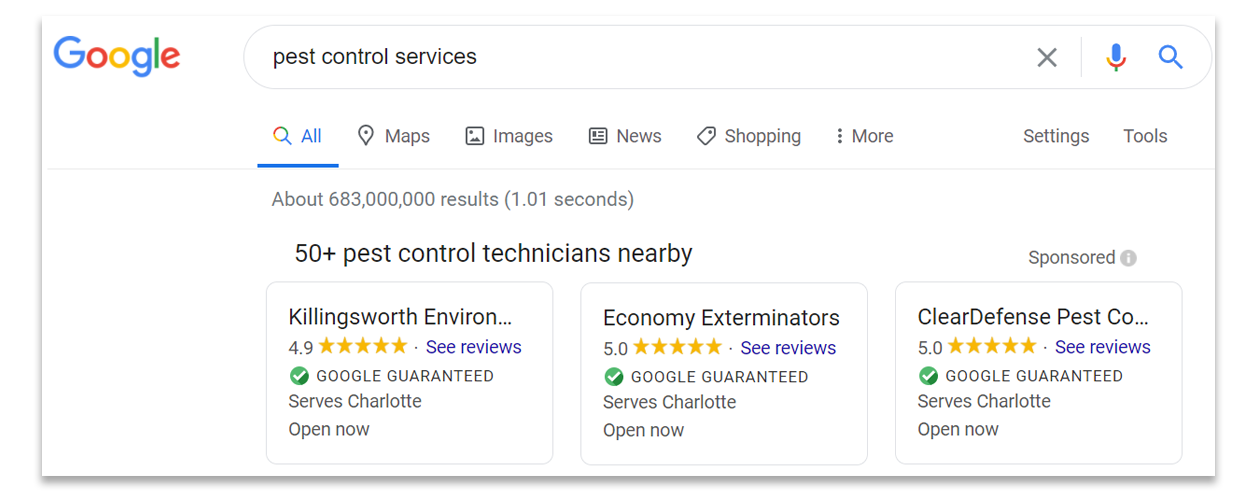
Google search results for pest control services, highlighting top-rated nearby providers with ratings and Google Guaranteed badges.

The 2025 Overhaul: What’s Different Now

If you set up LSA a couple of years ago, or you’re reading advice written before late 2025, most of what you know has changed:

  • One badge instead of three. Google Guaranteed, Google Screened, and License Verified are gone, consolidated into a single blue Google Verified badge in October 2025.
  • The money-back guarantee is gone. The old Google Guaranteed program included a consumer reimbursement guarantee of up to $2,000. That ended in November 2025. The screening requirements still apply, but the reimbursement program no longer exists, so update your own marketing if it still mentions “Google Guaranteed.”
  • Your Google Business Profile is now mandatory. Since late 2024, LSA requires a linked, verified GBP with business details that match your ad exactly. If your profile is unverified or suspended, your ads simply will not run, no matter your budget. (Haven’t claimed yours? Start with our guide to claiming your Google Business Profile.)
  • Your GBP reviews are your LSA reviews. The separate LSA review system was retired in mid-2025. Your Business Profile rating and review count now directly drive your ad ranking, and you need at least a few GBP reviews before your ads can serve at all.
  • Lead credits are automated. Google’s AI now automatically credits certain invalid leads instead of the old manual dispute process. It catches some junk leads and misses others, so watch your lead reports.

The through-line in all of it: Google keeps tying LSA more tightly to your Business Profile. A strong GBP is no longer just an SEO asset; it’s the engine behind your paid placement too.

How the Vetting Process Works

Google requires every LSA advertiser to pass screening before ads can run. The process varies by industry and location, but for pest control and lawn care companies it generally includes:

  • Background checks on the business owner and, in some categories, on employees who enter customers’ homes and properties. These run through Google’s approved partners (currently Pinkerton or Evident, depending on your category and region) and are free to your business.
  • License verification. Google confirms you hold whatever licenses your state requires for your trade. Requirements vary significantly by state and category.
  • Insurance verification. You’ll upload proof of general liability coverage; minimums vary by category and location.

Plan on roughly 2 to 6 weeks from signup to ads live, depending on how complete your documentation is and how many employees need background checks. And it’s not one-and-done: licenses and insurance must be kept current, and Google re-checks periodically. Let a policy lapse and your badge, and your ads, can be paused until it’s fixed.

It’s a hassle. It’s also the point: the vetting is what makes the badge mean something to customers, and it keeps the fly-by-night operators out of the top of the page.

Should Your Pest Control or Lawn Care Company Actually Run LSA?

Honest answer: it depends on your ticket size and your ability to answer the phone.

LSA tends to work well when your jobs are worth enough to absorb per-lead costs, and recurring pest contracts and lawn programs usually qualify, since you’re buying a customer relationship, not a single job. It works when you have a healthy review profile, because ranking in LSA is driven by review score and volume, responsiveness, and proximity, not by budget. And it works when someone actually answers calls quickly. Google tracks your responsiveness and ranks you accordingly, and a missed call is still a lead you may pay for.

It tends to disappoint when your Business Profile is thin or has few reviews, when nobody can pick up during business hours, or when you’re hoping ad spend can substitute for reputation. It can’t. That’s the entire design of the platform.

One more thing worth knowing: LSA doesn’t improve your organic rankings, but it stacks beautifully with them. LSA at the top, map pack in the middle, organic results below. Companies that hold all three own the page. That combination, plus someone answering leads in seconds instead of hours, is the actual formula.

How to Get Started

Sign up at ads.google.com/local-services-ads: enter your ZIP code, pick your category, and work through the verification steps. Everything is managed through the Google Ads platform now (the separate mobile LSA app was retired in early 2025). Budgets are set weekly, and Google manages spend within your cap.

Prefer to have someone who does this every week handle the setup, the verification paperwork, and the ongoing lead management? That’s part of what we do for pest control and lawn care companies every day. We’re always happy to help good people and good businesses win.